

Fitness & Wellness

Make Your Home A Positive Healthy Environment

Make Your Home A Positive Healthy Environment

Every day you hear about new dangers lurking in your home, whether it’s from toxins used for cleaning or problems with gas or electric lines. If you haven’t already focused on those environmental threats, it’s time to start. While you’re at it, you can improve the positive vibe in your home that will make its inhabitants glad to be there at the end of the day. It’s time to make your home a positive healthy environment by starting with more obvious problems.

Check for damage that can lead to danger.

A leak in the roof can cause damage to your home, but that’s not all. It can also cause mold to grow. The same is true for a leaky basement. Black mold is a danger that can cause respiratory problems plus chronic headaches. Even your air conditioning unit is a breeding ground for mold. If your home and all its contents are new, you’re not out of danger either. New carpeting, varnish, paint and furniture can release volatile organic compounds—VOCs. These toxic gasses can cause respiratory problems and even nerve damage. Airing out the house frequently can help with both problems. To remove the danger from new carpeting, get green carpet made from other materials without VOCs, such as bamboo.

How many bottles of cleaning products do you own?

Everyone wants a clean house, so there’ a whole grocery aisle filled with cleaners. Some are toxic, others aren’t. Try to use a natural green cleaner. Of course, the latest ones can be quite costly, so if you want to save money, go natural and simple. Distilled white vinegar cuts soap scum with ease. It disinfects as it cleans. Put it in a spray bottle and spray it onto the tub or sink and wait for a while then scrub off the soap scum. Use baking soda for a mild scrubbing action. Spray it in the toilet and let it alone for an hour, then brush away the rust and calcium and flush.

Making sure your home is a positive environment is up to you.

You’ll be amazed at how much smoother things can be when you have a schedule. It sounds really boring compared to flying by the seat of your pants, but it’s not. If everyone has daily chores, meals are preplanned and there’s a set bedtime, even for Mom and Dad, it can keep the house a happier place to be. Just like working out regularly and planning meals ahead can take the stress out of healthy eating and exercising, the same is true for planning the tasks around the house.

  • Limiting electronics can make your environment better and according to some of the latest studies, reduce the risk of depression in growing children. Make sure all computers are shut off and phones and laptops are checked at the door.
  • Keep your yard safe while controlling pests. There are a lot of natural ways to eliminate pests, from adding predator bugs to kill garden pests to using things like diatomaceous earth to control pests. It even kills fleas and bedbugs.
  • Save money on laundry while cutting back on toxic chemicals. Wool dryer balls could be the non-toxic alternative to dryer sheets you’ve been hoping to find. They don’t have toxic chemicals that are linked to damage to the endocrine and nervous system. Adding white vinegar to the final rinse also works.
  • Keep your cutting board fresh and free of germs by rubbing it with a half of lemon and letting it sit. Kosher salt can be sprinkled on first before you use the lemon scrub.


For more information, contact us today at Evolution Lifestyle Fitness


Nutritional Needs For Your Teenager

Nutritional Needs For Your Teenager

The nutritional needs for your teenager are different from yours. Teens are growing and changing at this time and that requires more nutrients and more calories than you require. To be their healthiest, they need something more nutritious than the average American diet. The higher caloric requirement, which is approximately 2800 calories each day for boys, which can be as high as 4,000 if they’re in sports and 2,200 calories for girls, which also increases for activity to up to 3,000. Adult men normally only require 2500 calories and women only require 2000.


Protein is important for teens.

Lean, healthy protein, such as protein from fish, dairy, poultry, meat eggs, or vegetarian options like most types of beans and Tofu is important to growing teens. They need it for muscle growth and development, which is often occurring quite rapidly in males and the physical changes that are taking place. Approximately 10 to 30 percent of their caloric intake should be protein.

Fresh fruits and vegetables should be served with every meal.

Too often food fresh from the garden is tough to find, unlike centuries ago when the family garden was where most food originated. Teens need to have a wide variety of colors on their plate to ensure they have all the healthy nutrients necessary. Not only do vegetables provide nutrients and energy, they provide fiber. Make sure your teen has five serving of varied fruits and vegetables each day. If you want to break it down further, they should have 2 to 2.5 cups of veggies and 1 to 1.5 cups of fruit.

Strong bones and teeth come from adequate calcium.

You might immediately think of milk when you think of calcium, but that’s not always the healthiest option. Some children can’t tolerate cow’s milk, while other studies show a diet that contains more than a glass of milk a day might decrease life expectancy. Instead, make sure there are viable high calcium options, such as almonds, lentils, broccoli, beans and dark leafy greens available.

  • One way to ensure your teen is eating healthy snacks is to make sure they’re available. Have veggies and dip, cubed melon or other healthy options ready for munching in the fridge.
  • Just like you, your teen needs healthy fat in his or her diet. Their brain needs fat for peak performance, so ensure whole eggs, fatty fish and avocado are on the menu and nuts are part of their snacks.
  • Go with full fat options, rather than choosing low fat alternatives, like low fat yogurt. When manufacturers remove some of the fat, they normally add extra sugar to make the food taste better.
  • Check out some of our recommendations for teens. We help them make smarter choices when it comes to what they eat. For instance, using brown rice, rather than white rice, provides fewer calories and more nutrition.

For more information, contact us today at Evolution Lifestyle Fitness


Olo Onuma featured in Weightwatchers Reimagined

Olo Onuma featured in Weightwatchers Reimagined

‘How to not blow your workout’ article by Weight Watchers online, asked Olo Onuma for his tip. Here is what he advised:

Olo Onuma advise for how to not blow your workout as seen in Weight Watchers Reimagined online


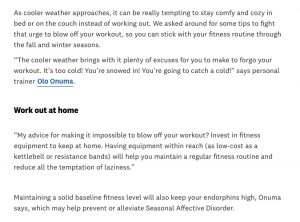
As cooler weather approaches, it can be really tempting to stay comfy and cozy in bed or on the couch instead of working out. We asked around for some tips to fight that urge to blow off your workout, so you can stick with your fitness routine through the fall and winter seasons.

“The cooler weather brings with it plenty of excuses for you to make to forgo your workout. It’s too cold! You’re snowed in! You’re going to catch a cold!” says personal trainer Olo Onuma.

Work out at home

“My advice for making it impossible to blow off your workout? Invest in fitness equipment to keep at home. Having equipment within reach (as low-cost as a kettlebell or resistance bands) will help you maintain a regular fitness routine and reduce all the temptation of laziness.”

Maintaining a solid baseline fitness level will also keep your endorphins high, Onuma says, which may help prevent or alleviate Seasonal Affective Disorder.


Ways To Get Your Kids Off Sugar

Ways To Get Your Kids Off Sugar

Early studies showed fat was the culprit for high cholesterol and plaque buildup in arteries, but the real villain in this case is sugar. Sugar is responsible for so many health conditions, not to mention lots of fillings and dental work. If you find your child gets unruly after eating sweets, it’s another good reason to get your kids off sugar and find ways to make eating healthy a treat.


Getting your child to eat healthy may not be easy, but it’s worth it.

Check the labels on the food you serve. Often sugar is one of the top ingredients. That doesn’t mean you’re out of danger. Manufacturers got wise to that type of shopping and instead of using one type of sugar, they use several types of sweeteners so all of them are further down on the list and you don’t know just how much sugar there is in the food. What’s the best way to fight this and make sure you control the sugar? Make the food yourself. Some people make a menu and shopping list one night, shop the next and cook the week’s meals, plus a few extra to freeze for later, on the weekend. That way, you don’t have to spend the time shopping or worrying whether sugar is hidden.

What your child drinks is just as important as what he or she eats.

Are you giving your child soft drinks? If so, stop!!! It’s nothing more than sugary flavored bubble water that’s high in calories. Fruit drinks are just as bad, since most only contain a little juice and lots of extra sugar. Even real fruit juice is high in sugar and can cause a spike in blood sugar, since the pulp/fiber in the whole fruit actually slows it. What’s the best option? Plain water is good, but if you want to make it fancy, make it fruit infused water with fruit slices in it. Kids love it.

Snacks without added sugar don’t have to be difficult to create.

Who doesn’t love a slice or two of apple with some chunky natural peanut butter. A bag of homemade trail mix is also good. Get some small snack size bags and put individual servings of mixed nuts in the bag for another healthy snack. Whether it’s young kids or teens, a bowl of fruit that’s already cut up is just an invitation for snacking. Slice up a watermelon or cantaloupe and set out a bowl so it’s ready for snacking.

  • Joining your kids in giving up sugar is a great idea. Did you know that too much sugar speeds up the aging process? That can’t make any adult happy!
  • Your children will be healthier when you reduce the amount of added sugar in their diet. Sugar negatively affects the immune system and lead to more illness and infections.
  • Sugar negatively affects cognitive thinking. One study shows that when sugar was removed from children’s diets at one New York school, the academic ranking went up 15.7%.
  • Don’t worry if your child eats some cake and ice cream at a birthday party occasionally, just don’t have it as a constant part of their diet. We have loads of recipes to help cut back on sugar.

For more information, contact us today at Evolution Lifestyle Fitness


Get The Kids Involved

Get The Kids Involved

I love the fact that we have something for everyone at Evolution Lifestyle Fitness in Raleigh, NC, whether the person is six or sixty. You can get the kids involved, while also working out yourself and bringing an aging parent in for exercise that can help keep them more independent. Our online fitness program can make it even easier to keep the family fit. Fitness should be a family affair. That scheduled workout and healthy meals can prevent long hours spent at the doctor’s office, while creating a family bond that lasts for years.


Healthy meals can be created by everyone in the family.

Today, meals are often eaten on the run or in the car or food is brought home in cartons and consumed in front of a television or computer. You can change all that and still have plenty of time. Kids can learn how to eat healthier and even help you create healthy meals on the weekend that are warm up ready during the week when it’s lunch or dinner time.

Kids can help and it makes healthy eating more fun.

If you want kids to snack healthier, make sure there are nutritious snacks available. Even younger children can help make snacks for the day or week. Ants on a log, celery stuffed with peanut butter that’s topped with raisins, is the perfect example of a snack kids can help make. Even a five year old can put those “ants” onto the log and add to the healthy snack. Older kids can help with all the food preparation and even provide some great ideas for healthy and delicious meals.

Keeping active can mean family fun time.

Kids learn what they live. If you and your family spend free time being active. Taking family hikes, biking, roller blading and even shooting hoops together will not only create a firm foundation for an active lifestyle, it will help make family memories that last a lifetime. Even working out together can be fun. You’ll not only be helping your children, you’ll be helping yourself in the process, too.

  • It’s not easy to be a parent today. There are often a lot of demands on your time. Whether working out together or preparing healthy meal options, doing it with the children can make give you quality kid time and be a great teaching moment.
  • Whether your teen is an athlete or not, he or she will benefit from a program of exercise. It helps build the body, while boosting confidence.
  • Studies show that children who exercise regularly have improved cognitive skills and behavior that helps them both in and out of the classroom.
  • At Evolution Lifestyle Fitness, your whole family can get one free private personal training session or a full week of group training. Take advantage of the opportunity and experience it yourself.

For more information, contact us today at Evolution Lifestyle Fitness


Weight Training For Kids

Weight Training For Kids

If you’ve read reports that weight training for kids is dangerous, my response is yes and no. Let’s look at the instances that may have a potential to affect the health of a child. Some studies show that weight training before puberty might lead to injuries, affect growth, while not increasing muscle strength. That’s only true when done improperly. The right form and correct safety measures must be taken and the program should be monitored and carefully planned to be its safest and most beneficial.


There’s so many more benefits to adding weight training to a child’s exercise program.

The best way to start a child in weight training is to make sure that their goal isn’t just about lifting as heavy as they can, but use lighter weights and focus on repetitions. Many studies show that pressing iron can help kids as young as 7. It helps build strength and that can actually help reduce the potential of injury, while improving sports performance. The goal of weight lifting training before puberty is not to build muscle tissue but to build strength.

Kids need to learn to follow the rules and instructions before they start.

No matter what your age, lifting weights properly and avoiding injury involve learning the proper form. Kids need to expect to master the form before adding any weight. The number of repetitions are more important than the amount of weight lifted. Strength training should be part of a well balanced fitness program that includes flexibility and endurance training. It needs begin with a warm-up and followed by a cool down.

Strength training can provide a great deal of benefits for kids.

When strength training, which includes weight training, is done properly, it can boost strength and endurance. It strengthens bones, maintains healthier blood pressure and cholesterol levels and helps reduce the potential of weight problems. (Canadian pharmacy) It helps kids in sports by protecting their joints and muscles from sports-related injuries. It also improves their performance in that sport or athletic outlet like dancing. It also helps the child learn the proper techniques for lifting. Consider that the next time you pull your back out from lifting wrong.

  • Strength training can help kids as young as seven. It’s important to have proper supervision from trained personnel teaching it. It’s always important to note that the primary emphasis should be on form, rather than on the amount of weight lifted.
  • Whether it’s an adult or a child taking strength training, doing it every day isn’t wise. Strength training sessions should be every other day or every third day if they’re strenuous.
  • Strength training can boost a child’s self-esteem and improve his or her overall confidence.
  • Evolution Lifestyle Fitness has trainers specifically trained to ensure that your child has the safest experience that maximizes the benefit to his or her overall health.

For more information, contact us today: evolutionlifestylefitness.com


Is Your Student Athlete Getting Enough Sleep

Is Your Student Athlete Getting Enough Sleep

Our children in Raleigh, NC, aren’t getting enough sleep. It’s an epidemic that first hit the adult population and now has invaded the young. It’s especially important for the student athlete or physically active young person that wants to succeed in their sport and is often the key to a winning performance. When you sleep, part of the brain and body is extremely active and the jobs done during REM sleep makes a difference both mentally and physically.


A recent poll found that 87% of America’s teens are sleep deprived.

There’s a lot of reasons teens are sleep deprived. Sometimes, it’s just the schedule. As teens move through puberty, their circadian clock makes a shift and they get sleepier later. Since school starts just as early and they can’t get the sleep they need. Smart-phones and electronic devices play a role, too. Making your child put down his or her smart phone an hour before bed ensures they’ll get approximately 21 more minutes of sleep. The busy life schedule with sports, social commitments and even the internet can keep a teen awake. Too much light in the bedroom from TV, cell phones and computers reduce the amount of melatonin, the sleep chemical in the brain. Even the attitude toward sleep, where being active is valued higher than sleeping and some sleep disorders can add to a cycle where the lack of sleep causes the teen to be more active and less apt to fall asleep.

Both young children and teens suffer when they’re sleep deprived.

You can understand how children or teens might have a difficult time waking up in the morning when they’re sleep deprived and probably already know they’re prone to hyperactivity and a short attention span. There’s a noted lack of coordination and clumsiness, which isn’t good for the student athlete. If you notice your child has more frequent colds and infections or problems with memory, anxiety or depression he or she could be sleep deprived. Many of the same symptoms are true in teens, but add to that poor decision-making, risk-taking behavior and slower reflexes.

The performance of teen athletes also suffers.

Whether it’s trying to decide whether to run with the ball or pass or focusing on the direction of the tennis ball, lack of sleep can jeopardize the performance on and off the field of a student athlete. One study shows that it definitely affected the ability to make split-second decisions. Lack of sleep also can slow post-game recovery time by decreasing the production, contribute to low energy and production of glycogen and affect speed, accuracy and endurance.

  • Adequate sleep is just as important as working out and healthy eating for the student athlete.
  • Studies show that teens may need even more sleep than younger children, whose requirements average 9 hours and 15 minutes a night, even though maturity allows their body and mind to remain alert later into the night.
  • Sports greats Serena Williams and Lance Armstrong both focus on getting more sleep. Armstrong endorses it on his website and Williams notes she goes to bed at around 7 p.m.
  • At Evolution Lifestyle Fitness we can help get your student athlete ready for the peak performance.

For more information, contact us today: evolutionlifestylefitness.com


Stop Childhood Obesity Before It Starts

Stop Childhood Obesity Before It Starts

There’s a surge in the percentage of children that are overweight, obese or extremely obese. It’s a phenomenon that’s world wide for both children and adults. It’s more prevalent in adults with half the adults being overweight, obese or extremely obese and one in every six child falling into those categories. While it is prevalent in America, it’s also high in Mexico, New Zealand and Hungry. Until recently, Japan and Korea were the countries with the lowest obesity rates, but as the Western food permeates the cultures, Obesity is rising in Japan due to a change to the Western diet. That tells you it’s primarily from the food eaten and a sedentary lifestyle. It’s easier to stop childhood obesity before it has a chance to start.


Start by focusing on eating habits.

It’s easy to understand why kids and adults gain weight. The American diet is horrible. Everywhere you look there’s an advertisement for sugary foods, burgers and fries. Fruit drinks are far removed from fruit juice and even juice isn’t as healthy as water and a piece of fruit. Even food that calls itself healthy, really isn’t. High fructose corn syrup may come from a natural source, but there’s nothing natural about it. The body doesn’t process it properly and it adds to the extra pounds in the population. Furthermore, it’s cheap, so manufacturers put it in everything. Eating healthy has become a lost art that’s hard to regain due to the changes in society.

Kids and adults are less active.

While I definitely wouldn’t want to go back to the days when children worked in the fields doing manual labor or we had no conveniences that made our work easier, America is just too sedentary. Our outlets aren’t physical, with many of them involving just the muscles of the fingers to type. Even work is far less active. This inactivity slows the metabolism and burns fewer calories daily.

The solution is easy to identify, but not nearly as easy to institute.

A healthier population needs to have a better diet and be more active. Both adult obesity and childhood obesity take their toll in type2 diabetes, increased risk of cardiovascular disease and increased risk of several types of cancer. It attacks the esteem of the obese person and creates social isolation. Switching to a diet of whole foods with limited processed foods and ensuring a program of daily activity or a protocol of fitness can reverse the problem. It’s not easy and it takes the efforts of the whole family.

You don’t have to have an obese child to understand how healthy eating and a program of fitness can help them grow up healthier and fitter with a longer life.

Eating healthy doesn’t have to become a huge fight. Making healthy switches to lower calories and increase nutrition can make the change barely noticeable. There’s a lot of healthy snacks your kids will love.

Too often children learn what they live. If you want your children to be more active, you should be more active, too. Plan fun family weekends of hiking, roller blading or bike riding. You’ll be making memories, having fun and improving everyone’s health.

If you’re not sure where to start, contact us at Evolution Lifestyle Fitness. We have programs to improve your fitness and ones to help you learn how to eat healthier. No matter what you or your child’s weight, there’s help for everyone to get fitter and healthier.

For more information, contact us today: evolutionlifestylefitness.com


Is Your Kid A Hidden Athlete

Is Your Kid A Hidden Athlete

There are lots of different skills required for athletics. While your kid may seem to be the most nonathletic individual you’ve ever met, there may be a hidden athlete under that veneer. All children take time to mature and develop. While they may not be athletic right now, that doesn’t mean that they can’t develop strength, endurance, flexibility and balance. Those are all the traits necessary for an athlete.
How do you define an athlete?

While not all parents look to their child to be the natural athlete that could make a pro football team without much training, being an athlete is more than that. It’s developing the mind and the discipline to become good at an endeavor that requires physical prowess. Athleticism can be defined many ways. It might be the ability to catch a ball, outrun a tackle or sink a basketball. It can also be the ability to run great distances, lift heavy loads and ride a bike faster than another. Every child has the ability to participate and do their best in some athletic capacity.

It’s determination, desire and direction that makes an athlete.

Learning to set goals and being held accountable for achieving them is one of the biggest benefits of becoming an athlete, but also one of the pre-qualifications for continuous superior athletic performance. Athletes love what they’re doing, often because they were good at it. Boosting a child’s belief in their abilities, providing them with a program to develop fitness and making it fun can help any child be more athletic.

Exercise can improve strength, endurance, flexibility and balance, plus so much more.

With practice and active participation the neural pathways in the brain develop to improve the body in a number of ways. It improves hand-eye coordination and other motor skills, but it also boosts cognitive thinking, problem solving, focus and other essential mental functions. It boosts the size of the hippocampus, which is directly involved with memory and learning, while also aids in the development of new brain cells. Even if a child is never a pro athlete, he or she will benefit from a program of regular exercise.

  • A shy child can get a boost of self-confidence and self-esteem from participating in a program of regular exercise.
  • While it might not produce an Olympic athlete, a program of regular exercise can improve social relationships and teamwork.
  • No matter what a person’s age—regular exercise can help reduce anxiety and depression. It’s a great outlet for reducing stress, even for children.
  • Early training in physical fitness can lead to a lifelong goal of healthy living and put your child on a path of good health.

Is Yoga Good For Kids?

Is Yoga Good For Kids?

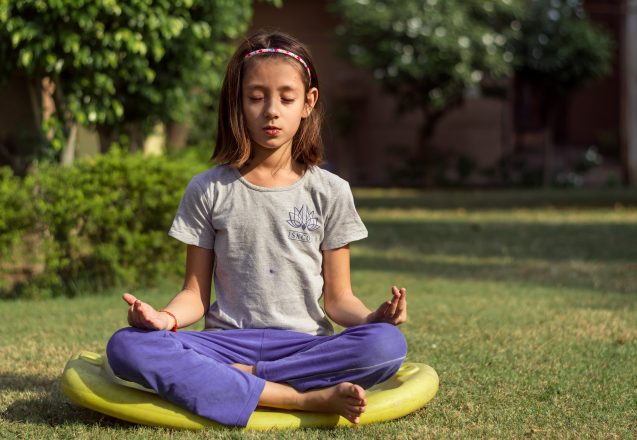
I have parents in Raleigh, NC, that are concerned for the health of their children, given so many more sedentary alternatives, like online games, are available. I understand their concern, which is why yoga, kids and all fitness training for children is an important part of our services. Kids learn what they live and there’s no better time to help them develop healthy lifestyle habits. Healthy eating and an active lifestyle is important, not only for a healthy childhood, but for continuing health throughout their lives.

Kids need an outlet that’s healthy and calming.

All exercise helps alleviate the effects of stress and today, even children face the stresses of everyday living. Childhood is far different than it was years ago and there’s more competition for grades, more distractions, more negative communication and even more bullying, although it’s not done with fists but through words. Finding an outlet that’s healthy that can relieve that stress is important. Exercise, particularly yoga, is one way to do that. It helps calm the mind, while building self-esteem and an improved body image.

Yoga and other types of physical activity have other benefits.

Flexibility, strength, co-ordination and endurance are built through activity. Yoga is based on concentration and a calming sense. It helps children learn focus and develop and inner strength that extends to dealing with the outside world. Yoga isn’t just saying “Ommm” and sitting contemplating self. It’s not easy. While it is mostly noted for the flexibility, it takes an amazing amount of strength, yet doesn’t require damaging physical contact as some sports do.

Yoga is fun.

Stretching like a dog or roaring like a lion is fun for younger children. For older children, the challenge of holding a position or even attaining a position is a challenge that is intriguing and keeps kids focused. No matter what type of exercise is used, keeping it fun and still challenging is one of the most important roles we face as coaches. It helps lead children down the road of lifetime fitness.

  • Yoga can be helpful to develop muscles and help avoid injuries in other sports. Some of our programs deal specifically with to correct imbalances and injuries to help prevent future injuries.
  • Yoga can be a perfect prelude to preparing for a sport. It helps build muscle strength in all areas that are necessary to maintain safety and boost performance.
  • Childhood obesity is rampant and growing. Yoga can help children be more aware of their body and the food they eat to nourish it. One study shows that yoga can encourage weight loss because it helps the participant be more body awareness.
  • Our program not only focuses on exercise, it helps them learn to set and achieve goals and the basics of healthy eating. It holds them accountable and teaches the important lesson of the benefits of commitment.